


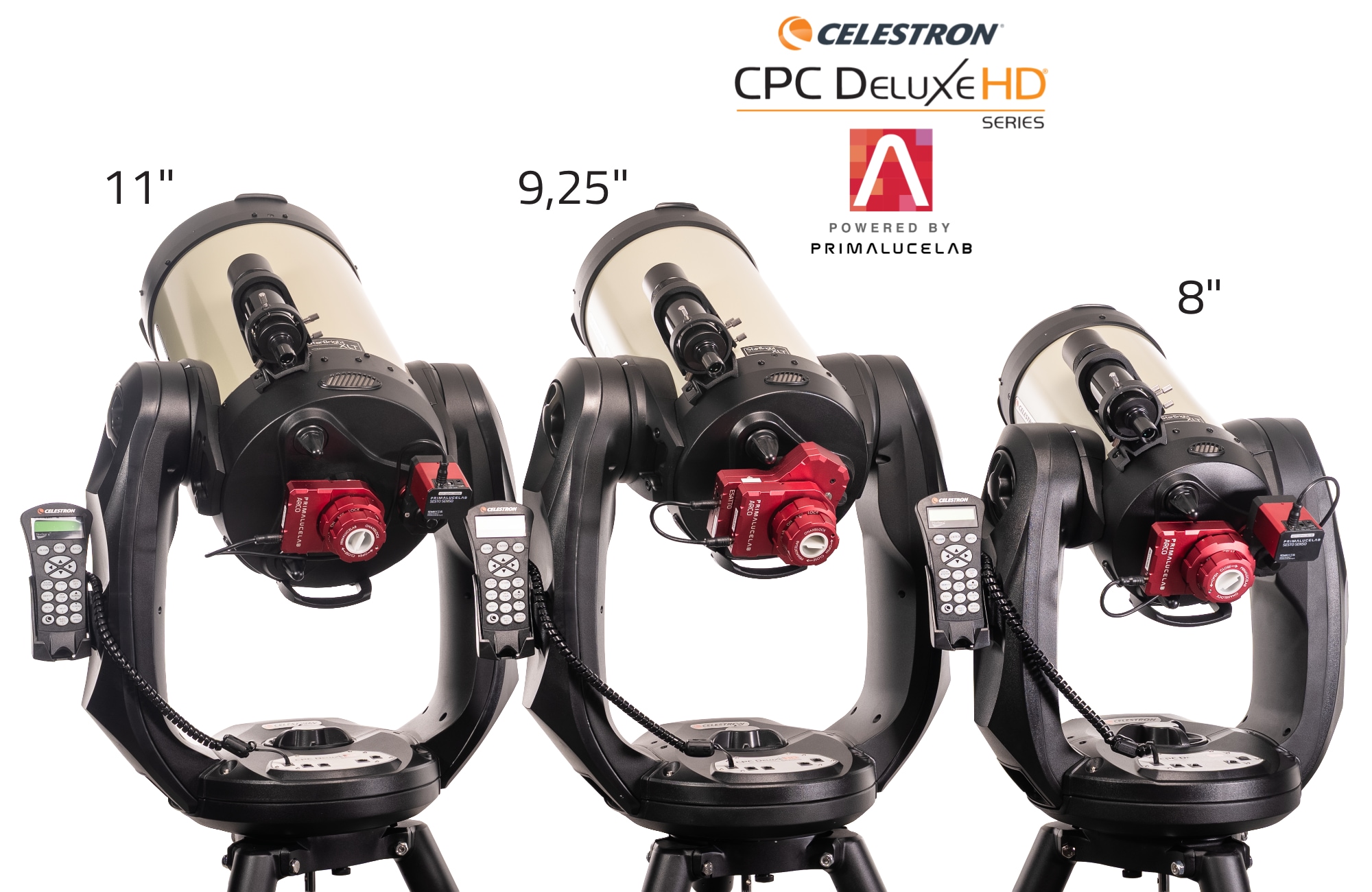
The CPC Deluxe HD powered by PrimaLuceLab telescopes are available in three apertures: 8″, 9.25″ and 11″. At first sight they look like the same instrument in three sizes, and in terms of capability they are: same aplanatic Schmidt-Cassegrain optical design at f/10, same computerized alt-azimuth fork mount, same ARCO field de-rotator, same control through PLAY. What changes is aperture, weight, optical performance, back focus and zenith clearance, focusing solution, and price. Some of these differences are obvious, others are not, and one of them is almost never discussed. In this article we go through the numbers you need to choose.
The numbers, side by side
| 8″ | 9.25″ | 11″ | |
|---|---|---|---|
| Aperture | 203mm | 235mm | 280mm |
| Focal length (f/10) | 2032mm | 2350mm | 2800mm |
| Light gathering vs 8″ | – | ~1.33x | ~1.9x |
| Weight, OTA and fork (no Base Kit) | 19kg (42lb) | 26kg (58lb) | 29.5kg (65lb) |
| Back focus, no reducer | 133mm | 146mm | 146mm |
| Back focus, with 0.7x reducer | 105mm | 146mm | 146mm |
| Focusing solution | SESTO SENSO 3 SC or ESATTO 2″ LP | ESATTO 2″ LP | SESTO SENSO 3 SC or ESATTO 2″ LP |
| Maximum single exposure time | 3 to 4 minutes | in between | 2 to 3 minutes |
Aperture and focal length: what they change
Aperture is the first thing to look at, because it sets how much light you collect and how much detail you can resolve. The 9.25″ collects about 33% more light than the 8″, and the 11″ collects about twice as much. For visual observing on the Moon, planets and faint deep-sky objects, this is the difference you see at the eyepiece.
But since all three models share the same native f/10 focal ratio, more aperture also means more focal length. At 2800mm, an arcsecond of tracking error covers more pixels than at 2032mm, so the same mount performance makes tracking accuracy more critical on the 11″. This is why the 8″ holds the longest single exposures of the three, and the 11″ the shortest.
Weight: one single piece
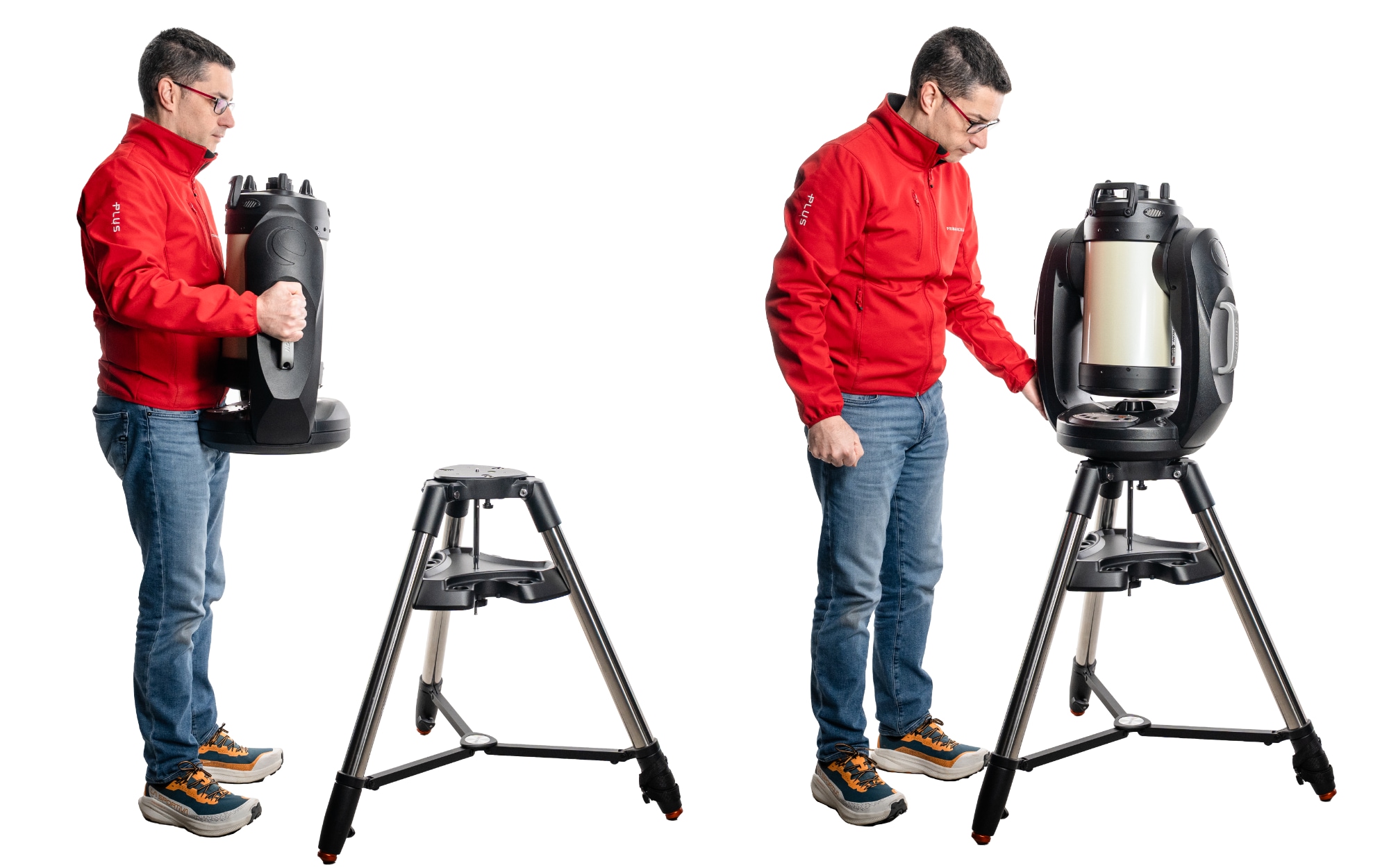
On the CPC Deluxe HD the optical tube and the fork mount are one single assembly. You cannot separate them the way you separate an OTA from a German equatorial mount, so the weight in the table is the weight you lift in one movement, before adding the tripod.
Without considering weight of the Base Kits, 19kg on the 8″ is a one-person operation. 26kg on the 9.25″ can be done alone, but a second person makes it comfortable. At 29.5kg, we recommend two people for the 11″, every time. This is not a detail: it tells you if you can move the telescope alone, or if you always need help.
Optical correction across the field
The three models are not the same optics scaled up. In the EdgeHD white paper, Celestron describes the differences (click here to read the white paper) and publishes the measured performance of each one.
The result is that the 9.25″ is the model that keeps diffraction-limited stars over the widest portion of the field, and the one that illuminates the field most uniformly, with the least vignetting at the edges. For wide-field imaging on a limited budget, it delivers excellent on-axis performance and outstanding images over the full 42mm image circle.
This does not make the 9.25″ a better telescope than the 11″. The 11″ still collects more light and resolves more detail. It means the 9.25″ is exceptionally well corrected for its aperture.
Focusing solution: internal or external
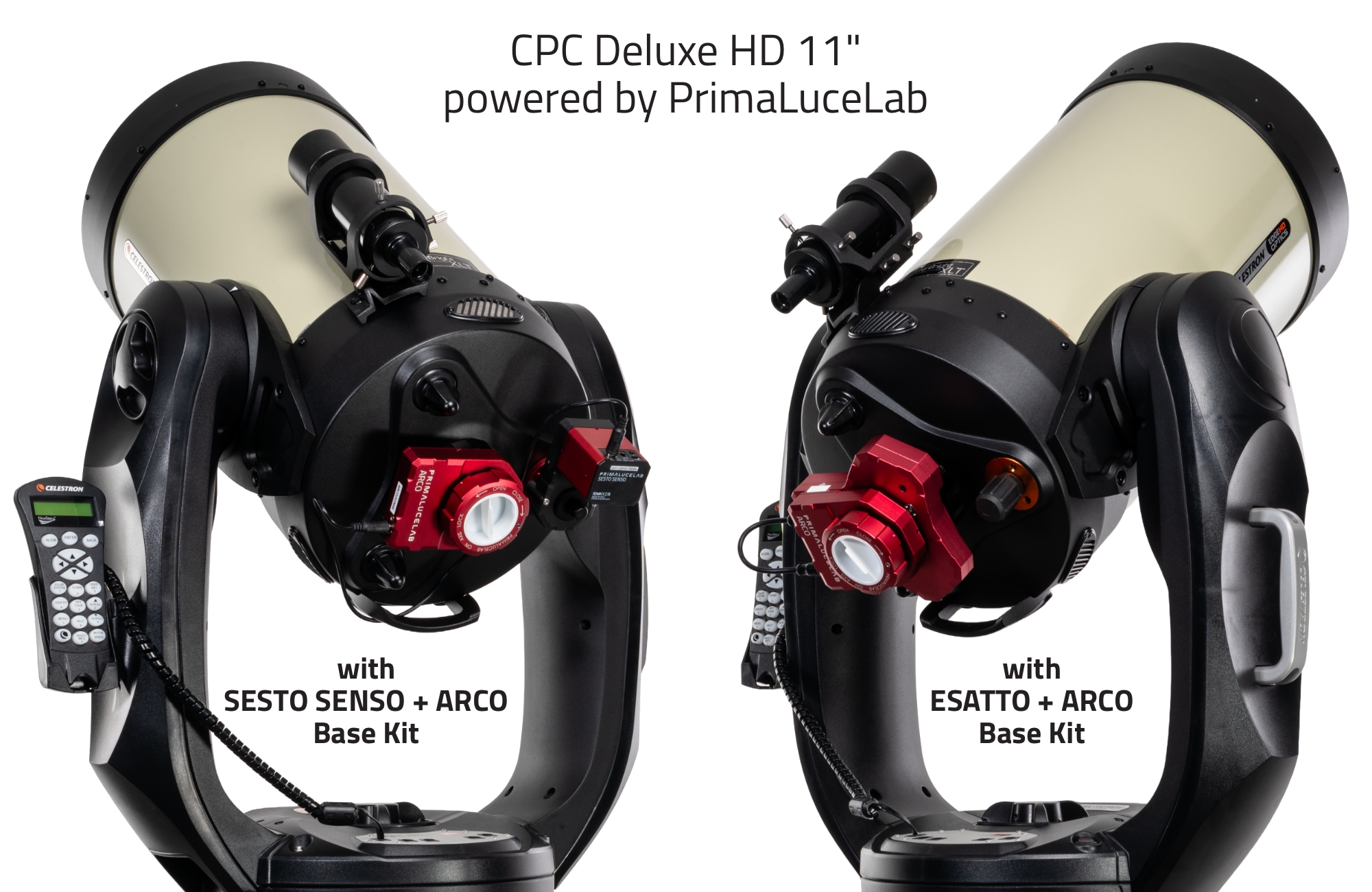
For the 8″ and the 11″ we offer two Base Kits. The SESTO SENSO + ARCO Base Kit motorizes the internal focuser of the telescope with SESTO SENSO 3 SC, and it is the most affordable way to enter the system. The ESATTO + ARCO Base Kit works differently: ESATTO 2″ LP is an external focuser that replaces the internal focuser completely. You lock the primary mirror, and from that point ESATTO moves the camera train, so mirror shift and backlash are no longer part of the focusing chain. On the 9.25″, ESATTO 2″ LP is the only configuration we offer.
Zenith clearance and back focus
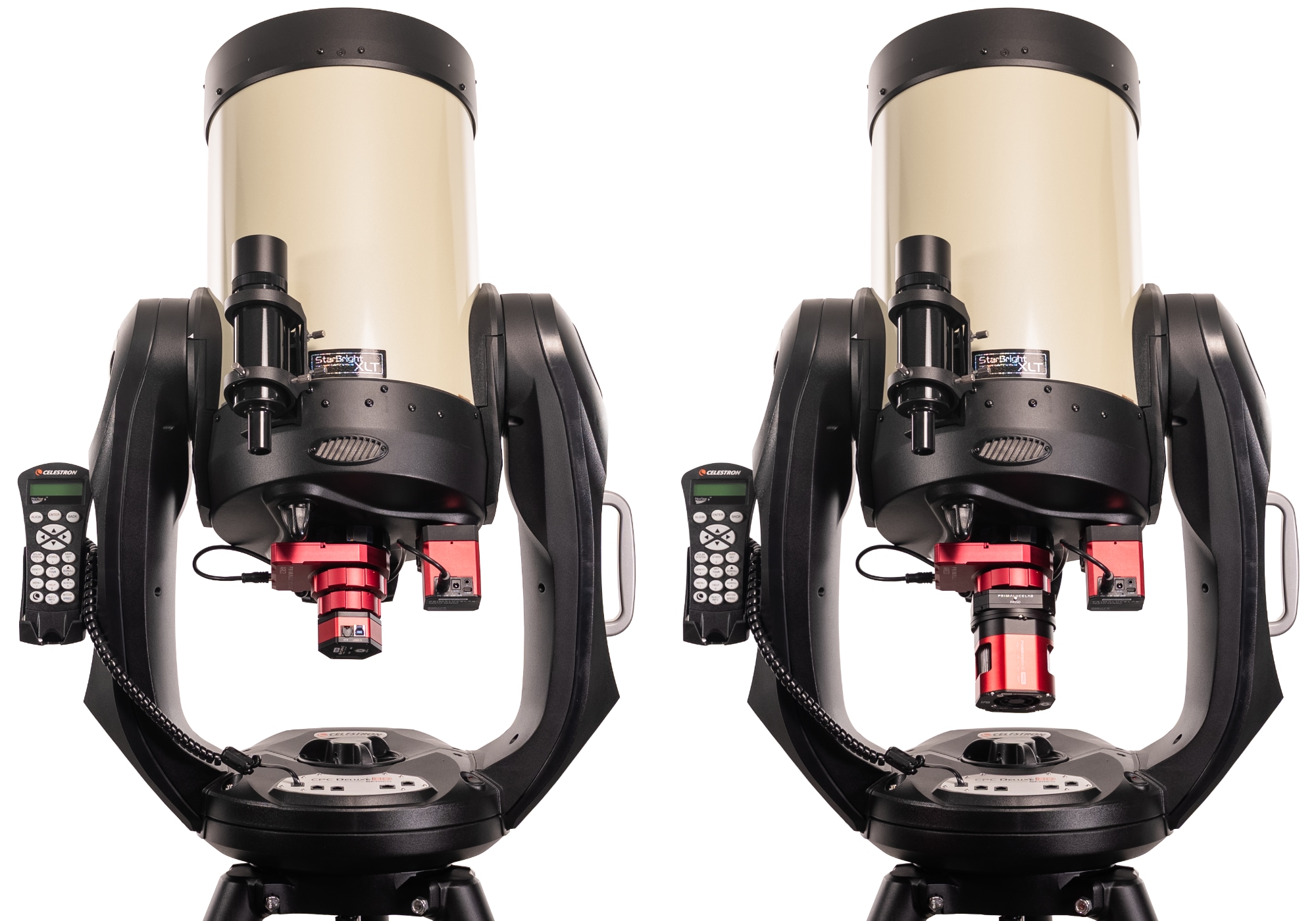
This is the specification almost nobody talks about, and on a fork mount it matters. When you point at the zenith, the camera train moves down towards the mount base, and the space available between the two is limited. That space is smaller on the 8″ than on the 9.25″ and the 11″.
Back focus follows the same logic. The 8″ requires 133mm without the reducer and 105mm with it, while the 9.25″ and the 11″ both require 146mm. With small sensors this is rarely a problem. With a cooled camera, a filter drawer and a full frame sensor, the total length of your camera train is a real design constraint, and it should be part of your decision on which CPC Deluxe HD powered by PrimaLuceLab to order.
So which one is for you?
The 11″ is for you if the telescope has a fixed place. Maximum aperture, maximum resolution, the best views at the eyepiece and the best planetary images. It needs two people every time it is moved, and the highest budget, so it is at its best in an observatory or permanently assembled in a garden.
The 8″ is for you if you have to carry your telescope. A balcony, a small garden, or a drive to a dark sky site: this is the one you set up alone in a few minutes. You give up light and resolution compared to the 11″, but a telescope you use often will always show you more.
The 9.25″ is for you if astrophotography is your main goal and you still want to observe visually. It is the best corrected of the three, it comes with ESATTO 2″ LP external focusing, and it sits in the middle for weight and exposure times. It is also the model we use ourselves for outreach evenings and when we show how to do astrophotography to friends.
Whichever aperture you choose, the platform is the same: open standard interfaces, control through PLAY, and the EAGLE Expansion Kit when you decide to add autoguiding and automation. The telescope stays under your control, and it grows with you.