

• Radio astronomy at school with SPIDER radio telescopes

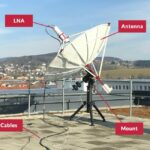
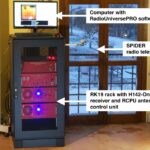
    Is it possible radio astronomy at school? In general, the activities that many schools develop in astronomy are usually made ​​with optical telescopes because instruments for other electromagnetic spectrum bands are considered too expensive or difficult to use. This often translates into single evening visits with students at the public observatories, so you can not conduct a continuous study. Thanks to our SPIDER radio telescopes is now really possible to make radio astronomy at school because, unlike an optical telescope, they can also be used during the day and then during normal lesson time! The SPIDER radio telescope is installed outside and it’s remotely controlled for example from the classroom or the laboratory.
  • Star Adventurer versus EAGLE CORE kit: astrophotography with DSLR camera

    Star Adventurer and EAGLE CORE kit allow you to track the apparent motion of the stars in the sky and, if you have a DSLR camera, allow you to record long exposures of deep-sky objects such as galaxies, nebulae or star clusters. But how long? In fact, the longer the exposition time that our instrumentation will allow us…

  • Celestron EdgeHD: versatile telescope, many applications

    Celestron EdgeHD telescopes are the evolution of classic Schmidt-Cassegrains: not only they can be used in visual (unlike the SC, they are perfect also with very large apparent field of view eyepieces) and for planetary and lunar photography but, thanks to dedicated focal reducers, they are great instruments for long-exposure astrophotography. In this article…

  • Telescope mount, what to choose: left the SkyWatcher AZ-EQ5 mount head that is smaller and lighter than AZ-EQ6 to the right, but offering a lower load capacity.

    Telescope mount, what to choose

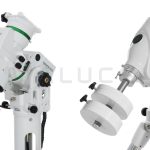
    Telescope mount, what to choose: “Power is nothing without control”, as stated by an advertisement, applies to telescopes as well, especially in astrophotography when taking long-exposure pictures of objects that are too faint to be seen. In fact, in order to take picture of celestial objects by using telescopes, it is…

  • PLUS: Prima Luce Universal System

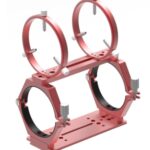
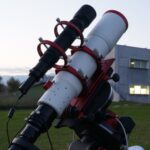
    PLUS is the system of dovetail bars and rings for telescopes designed by PrimaLuceLab in order to connect in a modular way telescopes and accessories in a stable manner and without flexures. All elements are made of high-strength aluminum, sandblasted, with high thickness red anodizing treatment. All PLUS elements are designed to…

  • The radio Sun

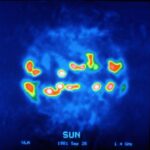
    The Sun is one of the strongest radio sources in the sky: if the part of the Sun emits more in the visible wavelengths is called photosphere, the radio frequencies born in the chromosphere and in the corona, the solar atmosphere. The solar surface has a temperature of about 6000K, and even if the gas at this temperature emits more wavelengths in the frequencies of visible and ultraviolet light, because of its proximity we can also record the radio emission.

  • A Backyard Observatory

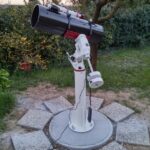
    One of the higher ambitions of many amateur astronomers is to have a backyard observatory. Who has available a sky with not too high light pollution in fact would like to have his telescope already installed and ready to use, without the need to assemble all the components each time to observe or…

  • Autoguide flexures

    Autoguide flexures: the use of an autoguider to improve the tracking accuracy of the telescope mount not only requires a sensitive camera and a good guide telescope (or an off-axis guider) but also a properly machined mechanical system that is able of supporting it without problems or flexures.

  • PHD Guiding, free software for autoguide

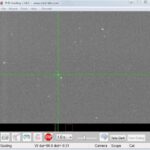
    PHD Guiding is a free software among the most used for autoguiding since it’s very easy to use. In this tutorial we will explain how to set up this software using an Atik TITAN camera but the same steps can also be made using other autoguiding cameras.

  • A compact radio telescope for amateur radio astronomy

    Is it possible to make amateur radio astronomy? If you already have an equatorial mount (the one used with optical telescopes) with at least 50 kg load capacity and Losmandy dovetail clamp (like an EQ8), thanks to the products developed by Radio2Space, you can turn your telescope into an amateur radio telescope, and start your amateur radio astronomy program without the need to have extensive knowledge of radio techniques.