

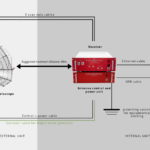
Build a radio telescope
Would you like for us to build a radio telescope at your location? Our team is able to ship to you and install one or more of our radio telescopes – here what you need to know beforehand.

Would you like for us to build a radio telescope at your location? Our team is able to ship to you and install one or more of our radio telescopes – here what you need to know beforehand.
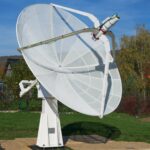
SPIDER 300A is the 3 meter diameter radio telescope that provides an affordable and compact solution for radio astronomy education and outreach! In this article we show the entire installation that we completed near Prague in Czech Republic on the behalf of a private user. In fact the SPIDER radio…
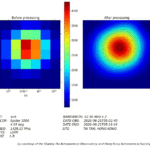
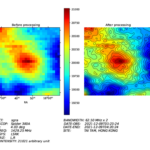
Compact SPIDER 300A radio telescope has been used to study the partial solar eclipse at 21 cm wavelength, with magnitude 0.89, in Hong Kong on 21st June, 2020. The radio telescope SPIDER 300A was designed and constructed by the PrimaLuceLab company, Italy. Radio flux density time curves (light curve) and a two-dimension mapping of the eclipse are presented in this paper. Standard radio data reduction methods were used to obtain the intensity time curve. We also adopted the semi-pipeline method for the reduction of data to obtain the same results as with the built-in software of the radio telescope SPIDER 300A. The total solar radio flux of the eclipse was found to reduce by maximum 55±5%, while the maximum eclipsed area of the same eclipse is 86.08%.
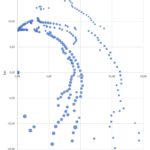
Our galaxy is an SBbc medium size and mass spiral type. It is only partially visible, since we are inside it; the plane of the disk and the thousands of stars it contains appear to us as a milky white stripe on the celestial vault, called the Milky Way. The Galaxy is composed of a central core, a bulge, a disk and a halo. In particular, the disc contains the spiral arms. The spiral nature of the Milky Way was confirmed through the study of the distribution of the HII regions, consisting mainly of bright nebulae of ionized hydrogen (HII) that form right inside the spiral arms. The spiral arms are regions of active formation of new stars, dominated by young stars, dust and gas.
In this conference paper, we present the development of radio astronomy in Hong Kong in 21 cm wavelength since 2006. We discuss the subtropical region with its usual cloudy condition in Hong Kong for launching radio astronomy. The MIT small radio telescope and Italy SPIDER radio telescope series were good starting points to create radio astronomy for a dense human populated region like Hong Kong. We present some interesting results with respect to these two types of radio telescopes. We also introduce the future possibility for the developing radio interferometry array in Hong Kong for research and teaching.
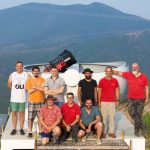
PrimaLuceLab team installed the BINO-SSA Observatory Station in Pampilhosa da Serra Space Observatory (PASO) in Portugal! BINO-SSA is the turn-key and affordable solution for Space Situational Awareness (SSA) and Space Surveillance and Tracking (SST) activities like the study of space debris and its classification. The version designed for Pampilhosa da…
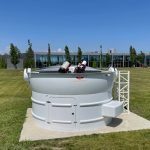
PrimaLuceLab Team installed a custom version of the DUAL-COMPACT Observatory Station in H-FARM (Italy), Europe’s largest innovation and education campus! DUAL-COMPACT is the Observatory Station with dome and dual telescope designed to provide an affordable solution for remote space exploration, astrophotography and astronomy education. The version designed for H-FARM uses…
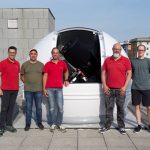
PrimaLuceLab Team installed a custom version of the ASTRO-RES Observatory Station in University of Milano-Bicocca (Italy): a turn-key astronomical observatory with Officina Stellare RiDK400 telescope, 10micron GM3000 equatorial mount, ScopeDome 3Mv3 dome, EAGLE remote control and power unit, ESATTO robotic focuser and GIOTTO smart flat field generator with ALTO telescope…
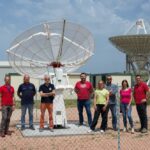
PrimaLuceLab team completed the installation of SPIDER 300A advanced radio telescope near Sardinia Radio Telescope, the wonderful 64 meter diameter single-dish radio telescope located in San Basilio, in southern part of Sardinia (Italy). Operated by INAF Italian National Institute for Astrophysics and ASI Italian Space Agency, SRT is used for radio…
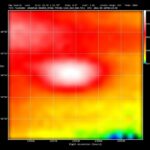
What are the results you can record with a radio telescope? In this article you can see spectra, cross-scans and radio maps you can record with SPIDER radio telescopes. When we record a picture of an Universe object, we usually use a digital camera that has many pixels (typically several millions). This way, when we record the picture, the light we receive “lighten” many pixel at the same time and each pixel records light coming from different sky areas. But, when we use radio telescopes, we record the signal from a single area of the sky (only large professional radio telescopes may have more LNA units), just as if our camera had only one pixel.